
I Inherited my Parent's Artwork. Now What?
A calm, practical starting point for families responsible for a single artist's lifetime of work.

Michelle
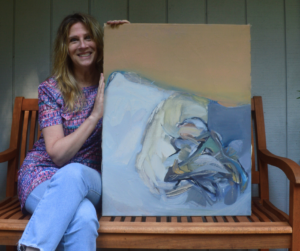
The earliest memory of my mother’s art is when I was around 6 years old and she taught us to stamp poster paints with potato stamps. It was messy, creative and great fun.
My Mom is now 85, and has been painting, collaging, printing and teaching art her entire career. I grew up surrounded by art, her artist friends and studio visits.
My own career was much different – I like systems, math and processes and although I still love art, I did not ever do anything with it professionally. It was my Mom’s thing.
Until last year, when she asked that I take it all over when she inevitably passes. And I froze.
- How many paintings are stacked in her studio back room?
- How many file drawers of paper work does she have there and home?
- What do I actually know about her as an Artist, beyond being her daughter?
- What on earth am I supposed to do with all of the artwork?
As I started talking to others, I realized that I am far from alone.
Her best artist friend has dementia, his son has hundreds of paintings, probably a thousand paper works to now deal with. Her other sculptor friend has alzheimers, his wife now has all his marble sculptures that can only be moved with a crane.
When you are suddenly responsible for someone else’s entire body of work, it can be overwhelming. We “kids” and spouses are often not artists ourselves, and are now thrust into the art world, and art market, often without the artist to help us navigate.
Additionally there are often costs of storage, studio rent or transport to deal with – which we could offset by selling the art, but to whom? For how much?
This is much different from inheriting a collection of art from an art collector. When you inherit artwork from an artist family member you are often dealing with :
1. The entire life of work from one person, potentially unsigned, undated and often without any sales, gallery or museum history.
2. The responsibility for the artist’s legacy, and keeping it alive.
3. An emotional relationship with the artist that is intertwined with the work itself.
Over the past year, I’ve spent time researching, speaking with artists, gallerists, art center directors, auction house owners, and families who have been through this. What follows are three initial, practical steps that can help reduce overwhelm and give you a place to start.
Before You Do Anything: A Few Things to Avoid (For Now)
If you can, try to avoid these common early mistakes:
- Don’t give away or sell work without taking a good photo of it first for your records.
- Don’t throw out notebooks or records from the artist before you have a chance to look through them.
- Don’t store the artwork in damp areas, or bright sunlight or areas with high temperature swings.
- Don’t ship/transport the artwork without careful handling
- Don’t think you need to be an expert in art, you can take small significant steps now
Three Initial Practical Steps to Get You Started
Practical Step One : Get to Know Your Artist as an Artist.
Take a moment now, and ask yourself – how well do I know this person as an Artist? (vs as a mother, a husband or a best friend.)
Start gathering whatever information you can:
- Website or online presence
- CV / Resume
- Exhibition / show / gallery / museum history
- Articles, interviews or reviews
- Awards, residencies
- Artist statement(s)
Try to determine commercial information:
- Who owns their work (collectors, institutions, friends)
- Is any work currently at galleries or art centers
- Records of when pieces were sold and for how much
- How pricing was approached
- Whether they made prints, or licensed work
It is perfectly ok if the artist never sold anything, or if not all of this information is complete. It is to help you understand the context of their career. Gather what you can.
Of course, it may be much easier if the artist is alive and available for you to ask them questions. But even then you might find that historical information is not available. And sometimes the artist themself can be reluctant to provide information. They may think it is all irrelevant, or assume their work “speaks for itself”. Many underestimate how hard it is for someone else to manage their art legacy.
Some artists have visions of what they want in their legacy – one artist I spoke to had a clear vision of her work in a retrospective show, with a specific theme and message. Which is wonderful! And very helpful to her family.
So get whatever you can, it will help you in both managing the legacy, and in any future efforts to place or sell work.
Practical Step Two : Protect the Art
This is probably the single most important piece of guidance I can provide.
Even minor damage can make artwork harder to exhibit or sell via galleries or art centers.
- Scratches to a frame
- Slightly warped paper
- Color or image fading
As a family member, this is often a big surprise and can sound unreasonable. Until you remember that the gallery or art center is also showing new work from other artists, right next to this piece – and the viewer/potential collector will see them all together. Show curators can not risk devaluing the other pieces of art.
So be careful of how paintings and framed work is stored.
- Do not stack or lean framed work directly against each other
- Keep works on paper (watercolor, ink, photography) out of direct sunlight
- Avoid places that are musty or damp (basements, attics, barns)
- Minimize big temperature swings
- Transport cautiously and carefully
Textile art, sculpture, collage, encaustic, wood … all mediums have their own sensitivities. Treat the art as if it will be shown shortly to a collector.
Not every family has the room, or the finances, to store work in this way. But even small improvements can help, for example: get work off of the floor, and put padding in between pieces that are stacked.
You do not have to decide how to sell it, or what to do with it, until you are ready. Until then, try to protect it as much as possible so it is in good condition when you are ready to make those decisions.
Practical Step Three : Identify the Core Body of Work (and What Can Wait)
I was surprised when one artist told me the first thing she would want her family to do when taking over her art is to destroy a bunch of it. “It is not my best work.” she said, and she would not want it to be part of her legacy, affecting how she is remembered.
That perspective can be uncomfortable for us as family members, but it is an important one. This doesn’t mean rushing to discard anything. It just means understanding what the artist themselves valued most.
So if your artist is still available for questions – ask them:
- What do you consider your strongest or most important work?
- Are there pieces that you are especially proud of and why?
- Is there work that you would not want us to display or share?
If you can’t, look for signals:
- Which works were exhibited, won awards or were written about?
- What appears consistently on their website or in portfolios?
- What was priced, editioned or carefully stored?
- What might have been set aside or treated as less important?
The goal is to get a sense of:
- Core works that represent the artist’s legacy.
- Secondary works that might be sold, donated or revisited later.
- Work that can wait until you focus your energy on the first two categories.
When I asked my Mom, her response was that she had identified in a notebook all the pieces she felt were “art with a capital A”, her best work. Everything else, she did not really care what we did, we could sell it, donate it or trash it. Good for us to know!
Take One Small Step
Managing an artistic legacy as a family member or friend comes with real emotional weight, real labor and often real costs. Feeling overwhelmed is normal. It means you care.
If you are not sure where to begin, choose one small action:
- Research one exhibition or show
- Move a few pieces to safer storage
- Review a small group of works together
Getting started with small steps and getting some things done helps dispel the overwhelm and give you energy to keep going.
Every artist is different, and every art legacy is different – if you have good tips on what helped or is still helping you, let us know in the comments!
I am still figuring this out myself. We learn best when we learn together. Let’s find ways to honor artists that also bring us meaning and even moments of joy.

Helping artists and families preserve creative legacies with care, intention, and the right tools.
“Your work is a garden. Let’s make sure it grows beyond you.”